
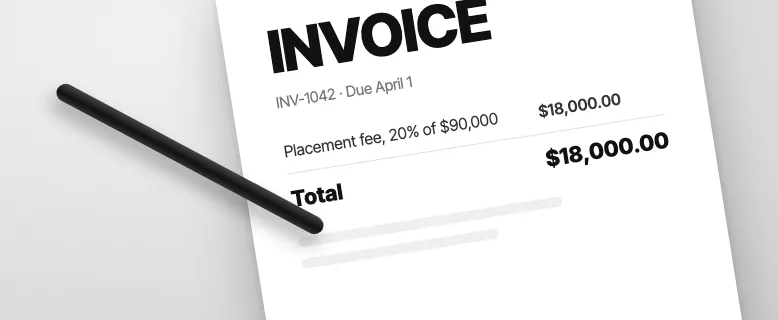
A placement isn’t finished when the candidate accepts. It’s finished when the client pays. Between those two points sits the invoice, and it’s where a surprising amount of agency revenue arrives late, arrives short, or gets argued about.
None of that is usually the client being difficult. It’s an invoice that went out a week after the start date, quoted a salary nobody agreed, or landed with someone in the client’s accounts team who had never heard of you. All of it is avoidable.
When should you send a placement invoice?
On the day your terms of business say the fee is due, and not a day later. For most contingency agreements that is the candidate’s start date, not the day they accepted the offer. Offers fall through between acceptance and day one often enough that invoicing early creates credit notes and awkward calls.
Retained search works differently. The fee is usually split into installments, for example a third on engagement, a third at shortlist and a third on completion, and each one is its own invoice on the date the agreement names.
Whichever it is, put the date in your calendar the moment the offer is accepted. A candidate starting on Monday, March 2 means an invoice dated March 2 and, on Net 30 terms, due April 1. Invoices go out late because the trigger is someone remembering, not something changing state.
What goes on a placement invoice
A client’s accounts payable team approves what it can check. Give them everything they need to match the invoice to an agreed hire, so it goes into the payment run instead of a query queue:
- An invoice number (INV-1042, say), the invoice date and the due date.
- The client’s legal company name and billing address, and the name of the hiring manager who approved the hire.
- The candidate’s name, the job title and the start date.
- The fee basis: the salary the fee is calculated on and the percentage, so the number can be checked rather than taken on trust.
- The fee amount, any tax as a separate line, and the total.
- A purchase order number if the client uses them. Many large companies won’t pay an invoice without one.
- Payment terms and how to pay: bank or ACH details, and who to contact with questions.
- A reference to the terms of business the fee was agreed under.
Show the math
The fee basis line does more work than any other. A candidate starting on $90,000 at a 20% fee is an $18,000 invoice. At 25% it’s $22,500, and writing "20% of first-year base salary of $90,000" on the invoice answers the first question accounts will ask. If you want to check a number or compare rates, the placement fee calculator does the arithmetic.
Agree the salary figure before the invoice, not on it. If your terms include a guaranteed bonus or sign-on payment in the fee basis, confirm the full package in writing when the offer is made. The invoice is the worst place for a client to discover what you’re charging on.
Payment terms and following up
Net 30 is a common payment term, and some agencies ask for Net 14, but the right one is whatever your terms of business say. Print it on the invoice as a due date, not just "Net 30", so there is a specific day both sides can see.
Then follow up on a schedule, not whenever you happen to notice. A simple one:
- 1Day 7: confirm the invoice reached the right person and that nothing is missing, such as a PO number.
- 2Day 30, the due date: if it hasn’t been paid, send a short reminder with the invoice attached again.
- 3Day 37: call. Most late payments are an invoice stuck in someone’s inbox, and a two-minute call finds out which inbox.
Keep it friendly. You want this client’s next role. And and the recruiter who chases politely and on schedule gets paid before the one who goes quiet and then sends an angry email.
What if the hire leaves during the guarantee period?
Invoice the full fee anyway. The guarantee or rebate clause in your terms decides what happens next: usually a replacement search, or a partial refund on a sliding scale tied to how long the person stayed. Handle it with a credit note against the original invoice, so both sides keep a clean record of what was billed and what was returned.
Do you charge sales tax on a placement fee?
It depends on the state, and on what exactly you’re selling. Permanent placement and temporary staffing can be treated differently. This is a question for your accountant rather than a blog post, and it’s worth asking before your first invoice rather than after your tenth.
Make the invoice part of the placement
Most invoicing problems come from the invoice living somewhere else: a spreadsheet, a separate accounting tool, a template in someone’s documents folder. The candidate’s start date is in one system and the reminder to bill is in someone’s head.
In Beagler, each invoice is created against the client and the placed candidate, so it stays linked to the placement it bills. Tax can be marked as included or excluded, the invoice is produced as a branded PDF, and it shows as overdue on its own once the due date passes, so nothing needs remembering.


