
A commission plan is the clearest statement an agency makes about what it values. Recruiters read it closely, work out what it rewards, and do more of that. Reward the wrong thing and you’ll get the wrong thing. Efficiently.
There’s no standard rate you can copy. Below are the common structures, with worked numbers, so you can see what each would cost you and what it would encourage in your team. The figures are examples, not a benchmark.
1. A flat percentage of the fee
The recruiter earns a fixed share of every fee they bring in. On an $18,000 placement with a 10% commission, that’s $1,800.
It’s simple to explain and simple to check. That counts for a lot. The catch: your recruiter’s first placement of the year pays the same as their twentieth, so the plan does nothing to cover what you spend on their salary before they bill.
2. A threshold, then a percentage
Commission starts only once a recruiter’s billings pass a threshold, often set as a multiple of their base salary so the agency recovers what it spends on them first.
For example: a recruiter on a $50,000 base with a threshold of $100,000 in billings, earning 20% above it. Bill $160,000 in a year and the commission is 20% of the $60,000 above the line, or $12,000. Bill $90,000 and it’s nothing.
This protects you and rewards your strongest billers. It can also demotivate anyone who falls behind early, because the threshold starts to look out of reach. Quarterly thresholds rather than annual ones soften that.
3. Tiered rates
The rate rises as billings rise: say 10% on the first $50,000 a quarter, 15% on the next $50,000 and 20% beyond. Each rate applies only to the billings inside its band, the way income tax brackets work.
Tiers give your best recruiter a reason to push for one more placement before the quarter closes. They are also the structure people most often get wrong when calculating by hand, so put a worked example in the plan itself, and check your own math against it.
4. A flat amount per placement
Some roles earn a fixed sum rather than a share, for example $500 to a researcher or sourcer for each candidate they found who was placed. It works for supporting roles whose effort doesn’t scale with the size of the fee.
5. Splits between recruiters
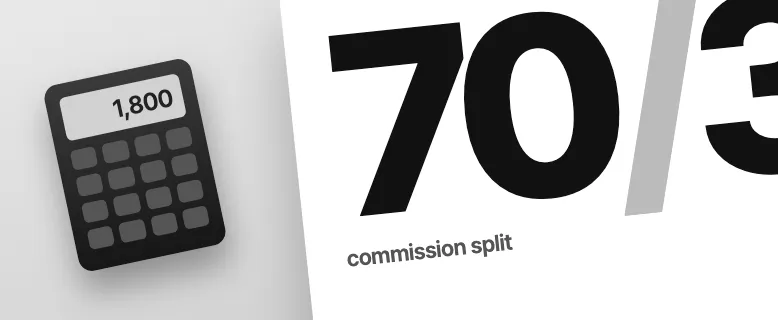
When two people worked one placement, typically the recruiter who owns the client and the one who found the candidate, the commission is divided. A 70/30 split of a $1,800 commission pays $1,260 and $540.
The rule that prevents arguments: split one commission, not two. Decide whose rate sets the pool, then divide that pool by the agreed shares. If each person’s own rate is applied to their share separately, the total paid out depends on who happened to be involved, and nobody can check it.
When is commission earned?
This matters as much as the rate, and it’s the part most plans leave vague. The two usual answers are when the candidate starts, or when the client pays the invoice.
- Paying on start rewards the recruiter sooner, but the agency carries the risk of an unpaid invoice.
- Paying when the client pays ties commission to cash the agency actually has, at the cost of a longer wait for the recruiter.
- Either way, say what happens if the hire leaves inside the guarantee period: whether the commission is held back until the period ends, or reclaimed from a later payment.
One more detail worth writing down: calculate commission on the fee before tax. Tax you collect and pass on isn’t revenue, and paying commission on it costs you money for nothing.
Put the plan in writing
A commission plan your recruiters trust is one they can check themselves. It should state:
- 1Who is eligible, and from what date.
- 2The rate or rates, with at least one fully worked example.
- 3What the commission is calculated on, and whether that is before tax.
- 4When it’s earned and when it’s paid.
- 5How splits are decided and divided.
- 6What happens on a rebate, a refund or a recruiter leaving.
Use the placement fee calculator and the recruiter commission calculator to run your examples, then check them against a few real placements from last year. If the plan would have paid something that surprises you, change the plan now rather than after the payout.
Stop calculating it by hand
The disputes in most agencies are not about the plan. They are about the spreadsheet: a placement missed, a split applied twice, a rate updated in one tab and not another.
In Beagler, each recruiter’s commission is set as a percentage or a flat amount, the agency chooses how placements are credited, including percentage splits, and whether commission is earned on hire or when the invoice is paid. The amount is calculated from the placement’s invoice before tax and carried into payroll for your team. It’s built for recruitment agencies and small staffing firms that would rather check a number than build one.


